

Friday 12th June 2026 delivered the answer. With Elon Musk ringing the market opening bell at Nasdaq as part of its IPO ceremony, SpaceX not only achieved the incredible, but in fact exceeded it: by the time the closing bell rang, retail and institutional demand had skyrocketed the share price past the target by over 19% to $160.95, effortlessly driving its market capitalisation past the $2 trillion milestone. At its session peak, it reached $176.52, and even on its closing price it made Elon Musk, who holds over 40% of SpaceX, the world’s first trillionaire.
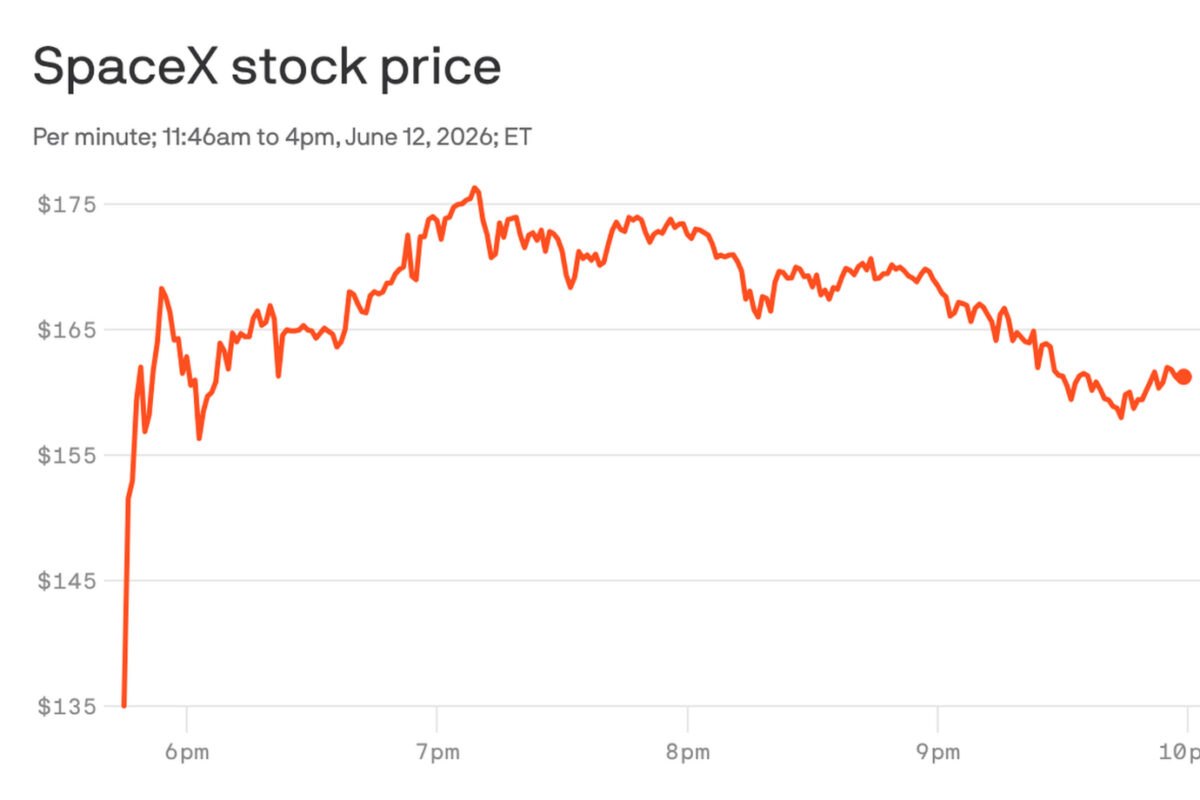
Chart: Erin Davis/Axios Visuals
So how did this company achieve such an extraordinary valuation, akin to Amazon despite generating 37 x more revenue than SpaceX? The answer lies beyond the balance sheet. SpaceX’s historic debut is a masterclass in the reputation economy – a definitive proof of how narrative, public relations, and a bulletproof corporate reputation can premium-price a business.
Whilst the reputation economy may be seen as a “soft” metric i.e. an intangible cost centre rather than a value driver, recent external research proves that corporate reputation operates as an explicit, quantifiable asset class.
According to Echo Research’s corporate value tracking, up to 26% to 28% of total market value among major stock indices is directly attributable to corporate reputation rather than physical or liquid assets, whilst the World Economic Forum (WEF) data also echoes these findings, estimating that more than 25% of a company’s market value is anchored directly to its public perception and brand equity.
These studies highlight how a company’s public relations architecture functions not as an abstract marketing expense, but as a primary driver of financial value. When traditional baseline fundamentals would dictate a more conservative target, corporate reputation fills the gap, functioning as an economic shield and an amplifier for future cash flows.
And no other brand exemplifies this better than SpaceX. For instance, when cascading their corporate newsflow into the market, they rarely do so by simply issuing standard corporate press releases. Instead, every rocket launch and Starship booster catch is treated as a globally synchronised, high-stakes livestream event.
By turning aerospace manufacturing into an open, participatory saga, their PR strategy fosters intense retail and institutional affinity. During its IPO, SpaceX leveraged this enthusiasm by reserving an unprecedented 30% allocation for retail investors, thereby effectively transforming general brand fans into aggressive market buyers.
In crafting an IPO that was simultaneously unmissable and aggressively starved for supply, the SpaceX communications team manufactured institutional-grade FOMO (fear of missing out) at a massive scale. The end result was an avalanche of over $250 billion in total demand across both institutional and retail, outstripping the $75 billion raise by nearly four times.
This explosive public market entrance of SpaceX shows that perception directly commands capital allocation. Financial analysts may construct models based on strict discount rates, but human buyers trade on trust, vision, and corporate narrative.
PR is therefore not a defensive tool reserved for managing institutional crises. It is an active offensive economic lever. When executed with precision, a highly calibrated reputation strategy expands your valuation limits, lowers market-based risk, and converts abstract future potential into concrete balance sheet wealth.


